


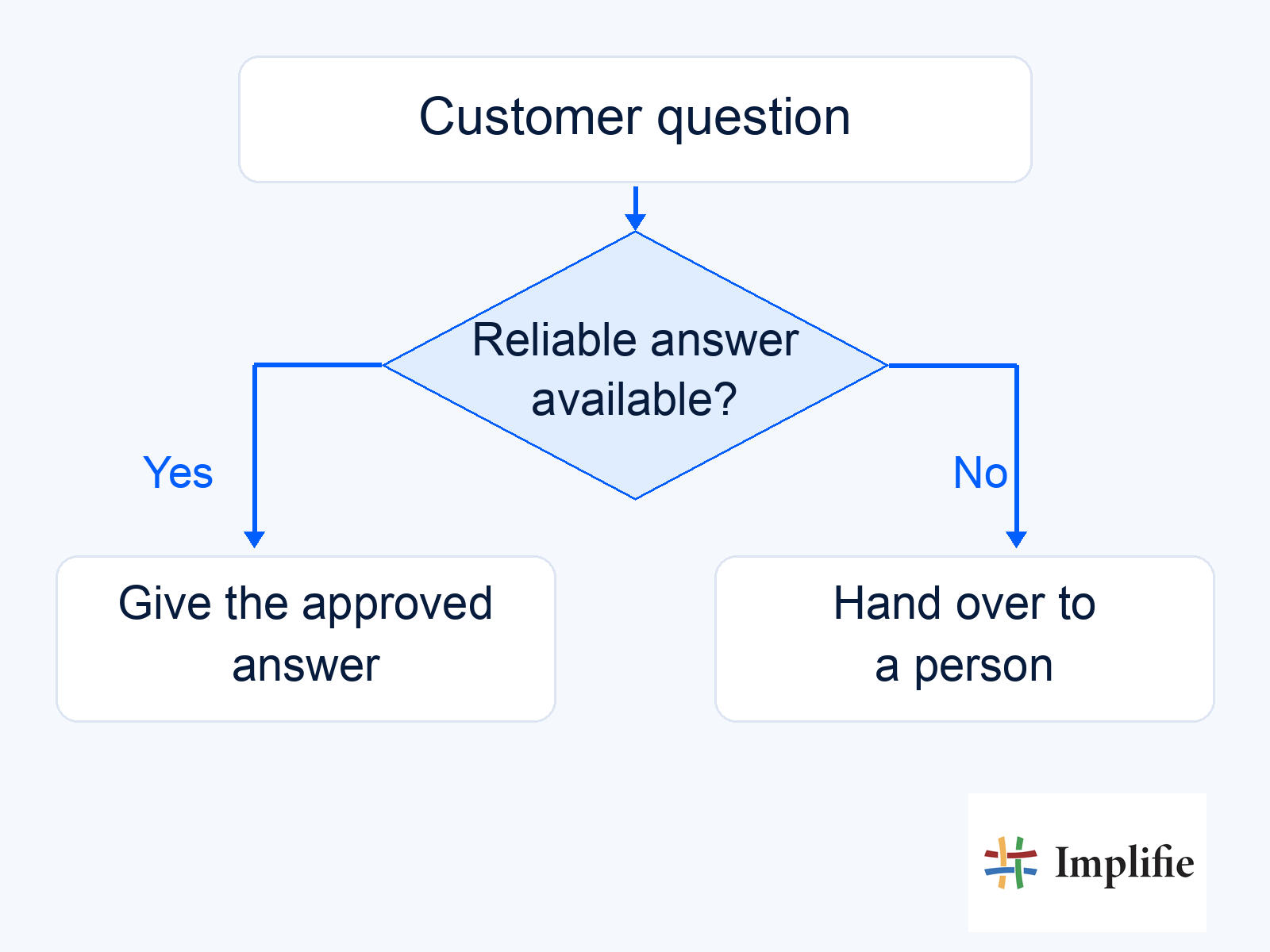
A bot that answers every question is a poor starting requirement. A useful WhatsApp bot strategy decides which customer task should be automated, what information makes the answer reliable and where a person must take over. That decision comes before drawing a large flow. If a task requires a judgement your business has not defined, or an external action you cannot verify, automation can make the uncertainty harder for the customer to see.
This guide is about scope, ownership and evaluation. The separate first-chatbot setup guide covers building a focused initial flow. For education-consultant enquiries, a sensible automated task might collect the programme and intake of interest, then route the enquiry. It should not make an unsupported eligibility, admission or visa decision. The boundary is part of the customer experience, not an inconvenience to hide.
Set the scope of your WhatsApp bot strategy
Look at recurring conversations and identify a task with a recognisable result. Answering approved opening-hour questions, collecting the context for an enquiry and checking a supported order status are different tasks. Describe what success looks like for each and what could go wrong. A frequent question is not automatically a good automation candidate if the answer depends on information that changes and nobody owns the source.
| Task condition | Suitable starting pattern | Human responsibility |
|---|---|---|
| Stable approved answer | Provide the current information with an exit route | Maintain the answer and handle exceptions |
| Predictable missing details | Ask focused questions and save the context | Review the requirement and next decision |
| Verified connected record | Read the permitted result through the supported connection | Resolve mismatches and unavailable data |
| Judgement or commitment required | Collect context and hand over | Make the actual business decision |
| Unclear or sensitive request | Offer clarification or a human route | Assess the situation without invented answers |
Prioritise by the customer benefit and the effort needed to keep the task correct. A narrow, maintainable journey can be more valuable than a large bot with many abandoned paths. Review the current enquiry volume, repeated questions and the receiving team’s workload, then choose one scope you can test end to end. Avoid setting a fixed percentage of “human-free” conversations as the objective before checking which requests need a person.
Set the information and action boundaries
Name the approved answer source and the person who updates it. If the bot needs a live record, identify the supported connection and the access it requires. A chatbot workflow can ask questions and route requests, while a flow builder provides conditions and actions. Neither eliminates the need for current information or establishes that an external action succeeded just because the customer reached the next screen.
- Can answer: List the questions supported by current approved information.
- Can collect: Identify the details needed for the next responsible action.
- Can act: Confirm the permitted connected actions and success evidence.
- Must hand over: Name the exceptions and decisions requiring a person.
- Must stop: Define the conditions that end or pause the journey.
Design the handoff before enabling the bot
Specify which team receives an exception, what context it receives and what the customer is told. A shared inbox can support assignment, while the customer record retains relevant answers. Check whether a colleague can resume without asking the same questions again. If a person is unavailable, explain the actual next step rather than promising an immediate response the business cannot provide.
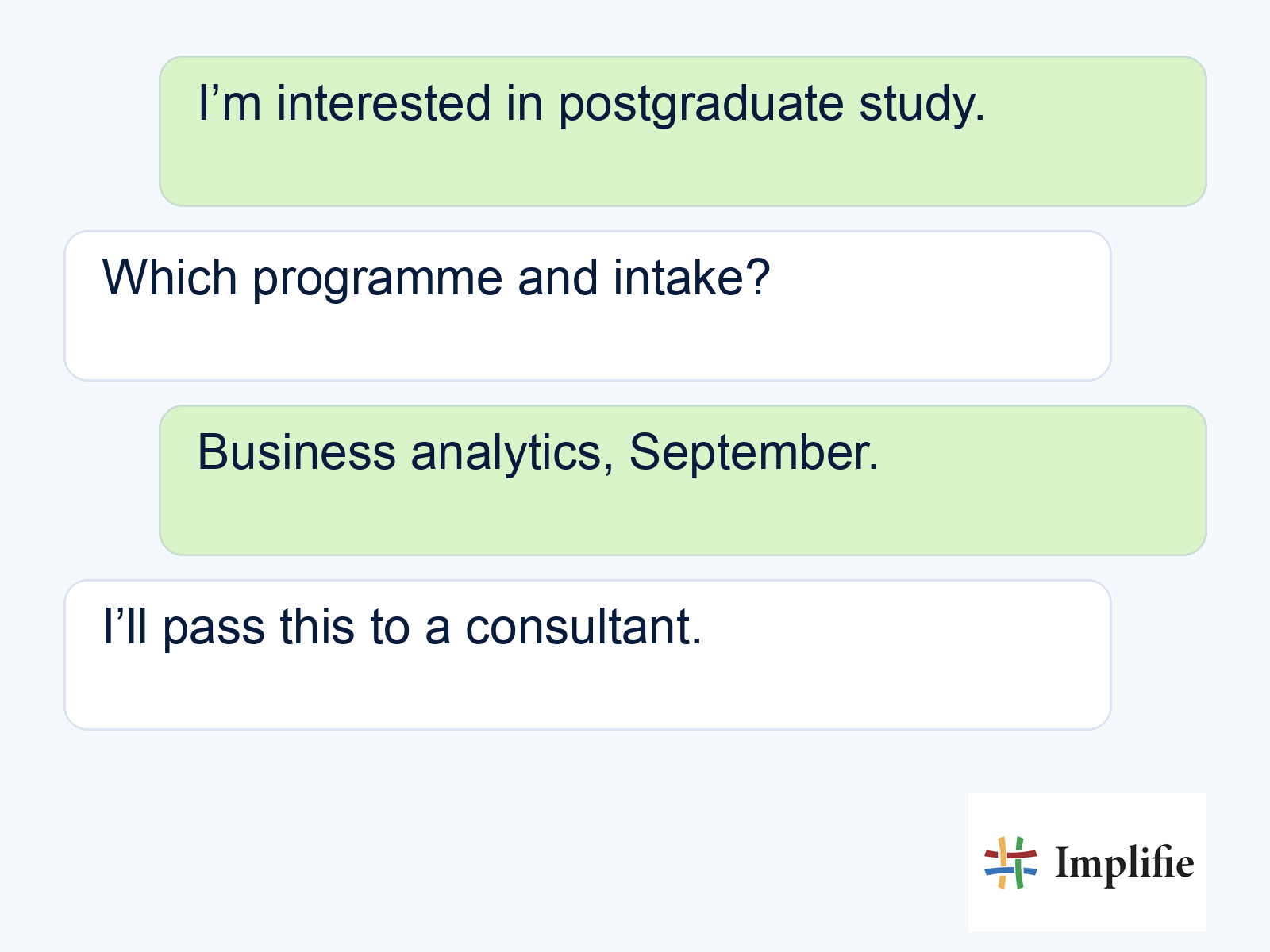
The example below is a fictional course enquiry. The bot collects the programme and preferred intake, then passes the request for a person to review. It does not claim that the applicant is eligible or that a place is available. Keep the essential process in the article and operating plan: collect the relevant interest, acknowledge any missing information and route the decision. A useful handoff makes the limit clear without making the customer restart.
Test the result, including disagreement and failure
Define the expected outcome before testing a route. Ask someone unfamiliar with the design to try a normal question, incomplete information, a request outside scope and a direct request for a person. Check a customer who corrects an earlier answer and a connection that cannot provide data. A correct handover is a successful outcome when the task genuinely needs it. Do not classify every escalation as a failure just to make the automation rate look better.
Review whether the bot explains the answer accurately and whether any claimed action actually occurred. A requested appointment should not appear as a confirmed booking without the source record. A saved enquiry should not be reported as a sale. Where AI assistance is used, test the allowed information and action boundaries separately from fixed questions. A friendly tone does not compensate for an unsupported answer, and a confident response can make a wrong assumption more harmful.
Assign maintenance and a way to pause the journey
Appoint an owner for source information, workflow changes and unresolved questions. Record which routes are affected when the product range, service terms or team availability changes. Test those routes again after an edit and keep a practical way to pause the affected automation. The business should be able to explain why a particular message was sent and which version of the underlying information it used.
Use conversation reporting with a review of actual outcomes: correct resolution, repeated contact, handover completion and necessary corrections. Compare those results with the prior process where practical. A high number of automated replies can hide a poor customer experience if people keep asking the same question. Improve the source or scope when that happens, rather than adding more automatic responses to the same unresolved problem.
Keep the bot useful after launch
A dependable WhatsApp bot strategy combines a limited task, a trustworthy information source and a clear human route. Test what happens when the answer is missing, the customer changes direction or the connection fails. Maintain the flow as the business changes and judge it by completed customer outcomes. Expand only when the next task has the same clarity of ownership and evidence.
Frequently asked questions
Should the goal be to remove every human interaction?
No. Some requests require judgement, permission or investigation. Define successful resolution and useful handover instead of forcing every conversation through automation.
How is strategy different from flow setup?
Strategy decides scope, information sources, ownership and success criteria. Setup implements and tests the selected journey.
Is an escalation always a bot failure?
No. Escalation is appropriate when the task requires a person or the necessary information is unavailable. Check that the handover actually completes.
What should change after a policy or product update?
Update the authoritative information, review affected routes and test them again. Pause inaccurate automation until its owner verifies the change.
