


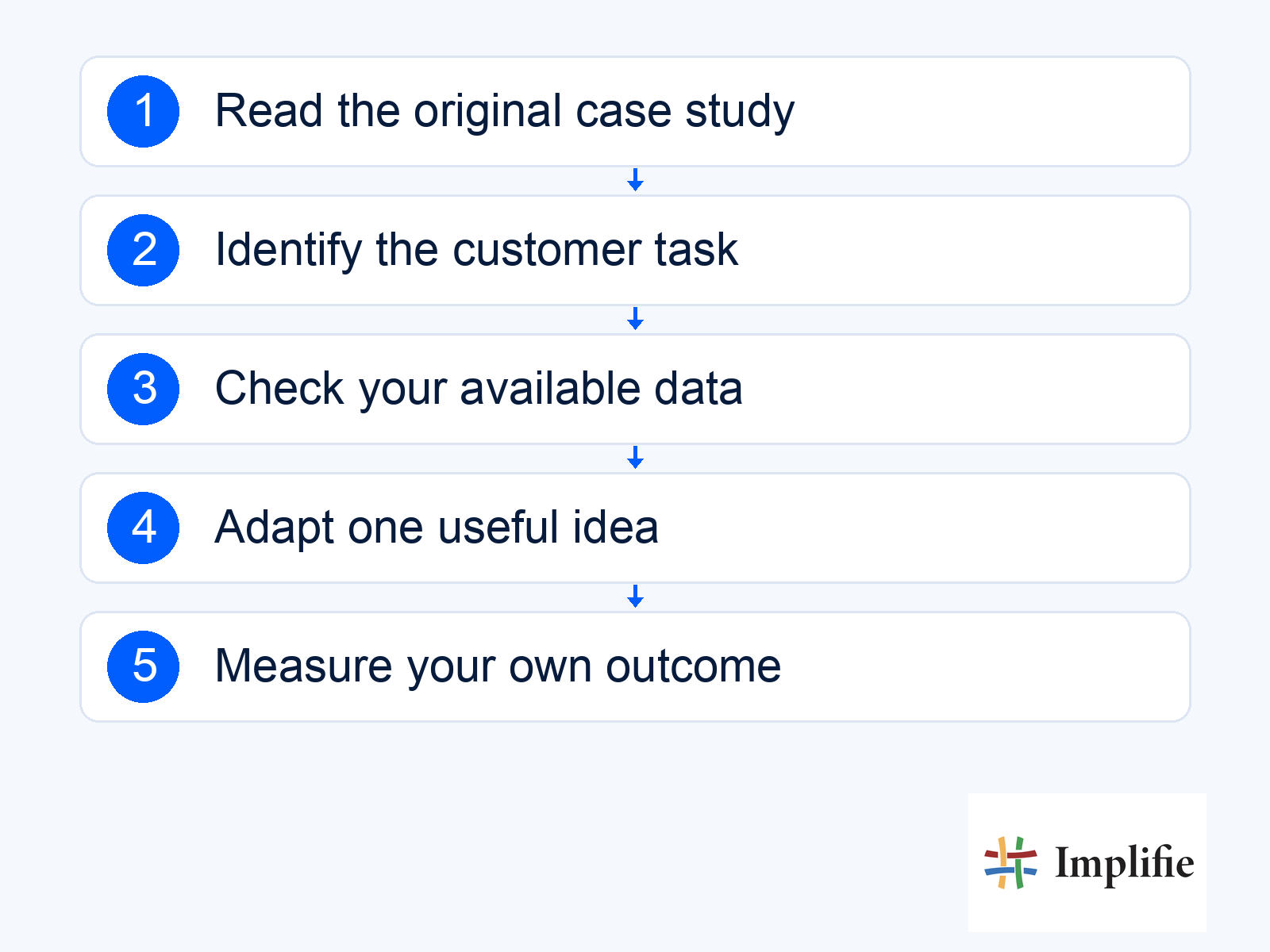
The useful question behind WhatsApp marketing success stories is what made a customer’s next decision easier. A large sales figure on its own does not tell you whether the audience, offer or operating process would work for your business. This guide looks at two documented examples, explains the practical lesson in each and shows how a smaller team can test a related idea. These businesses are not presented as Implifie customers, and their reported results are not promises for an Implifie campaign.
The examples come from WhatsApp’s own published case studies. They describe different businesses, markets and implementations, so they should not be ranked as if they were one controlled experiment. Read the source, separate what the brand reported from our suggested application, and choose a customer problem you can actually support. For a retail WhatsApp journey, that might be helping an interested shopper choose a suitable item rather than launching a large campaign immediately.
Tata CLiQ: make WhatsApp campaigns relevant to shopping intent
WhatsApp’s Tata CLiQ case study describes a staged rollout with Gupshup: order-related notifications came before more personalised campaigns. Later messages used signals such as browsing interests, abandoned carts and price changes for wish-listed products. The source reports higher engagement and sales attributed to those campaigns, while noting that results are specific to the featured business. It is evidence of a particular implementation, not proof that sending the same message to any customer list will reproduce it.
The lesson we would adapt is to connect a message to a recent, understandable customer interest. For a small store, one verified product preference is more useful than an ambitious segmentation model built from incomplete records. Check whether the item is still available, whether the customer remains interested and which colleague can answer a reply. A WhatsApp CRM record can help retain that context. Avoid presenting inferred preferences as something the customer explicitly requested.
Magalu: connect product discovery to the next buying step
WhatsApp’s Magalu case study describes Lu’s Brain, a Brazilian conversational shopping experience combining AI assistance, product information, WhatsApp Flows and payments. The source reports results over a six-week period in late 2025 and explicitly describes them as self-reported. Its payment implementation includes Brazil’s Pix system. That market-specific setup should not be presented as a ready-made payment experience available to every Indian business or on every software plan.
Our practical takeaway is to reduce the gaps between a product question and a supported next action. Start by checking which information the buyer needs: size, availability, price or delivery coverage. Then connect the answer to the actual catalogue and checkout process. Implifie’s commerce conversations can support configured shopping workflows, but a brand’s custom AI system is not evidence that an identical implementation exists in your account. Validate the data source and supported action before making that promise to a customer.
| Example | Documented approach | Question for your own business |
|---|---|---|
| Tata CLiQ | Personalised notifications linked to shopping behaviour | Do we have reliable interest and availability information? |
| Magalu | Connected product discovery, assistance and checkout in Brazil | Which parts of this journey are supported in our market and setup? |
| Your pilot | One clearly defined customer task | Can we measure the outcome and handle every reply? |
Turn a success story into a small, testable campaign
Choose the smallest useful idea rather than copying the whole experience. A retailer could invite customers who asked about an item to check its verified availability. A restaurant could help interested diners find the current menu and request a reservation, while leaving confirmation to the actual booking process. These are hypothetical adaptations, not additional case studies. The same approach applies to restaurant WhatsApp enquiries: be clear about which action is requested and which action has been confirmed.
- Customer task: Write the question or decision the message helps with.
- Evidence needed: Identify the current product, price, booking or order information required.
- Audience: Select people for whom that task is relevant and who are eligible to receive the message.
- Reply owner: Assign the colleague or supported workflow that continues the conversation.
- Success event: Choose a completed action you can verify, rather than counting a click as a sale.
Show the conversation your team can actually support
The following illustrative exchange is our own example of a product enquiry, not a reconstruction of either brand’s campaign or a customer testimonial. It shows how a useful question can narrow the next action without inventing stock information. Keep the essential wording in the article as well: ask which size the buyer needs, check that exact variant and explain the supported purchase route. If the connection cannot confirm availability, route the question to someone who can.
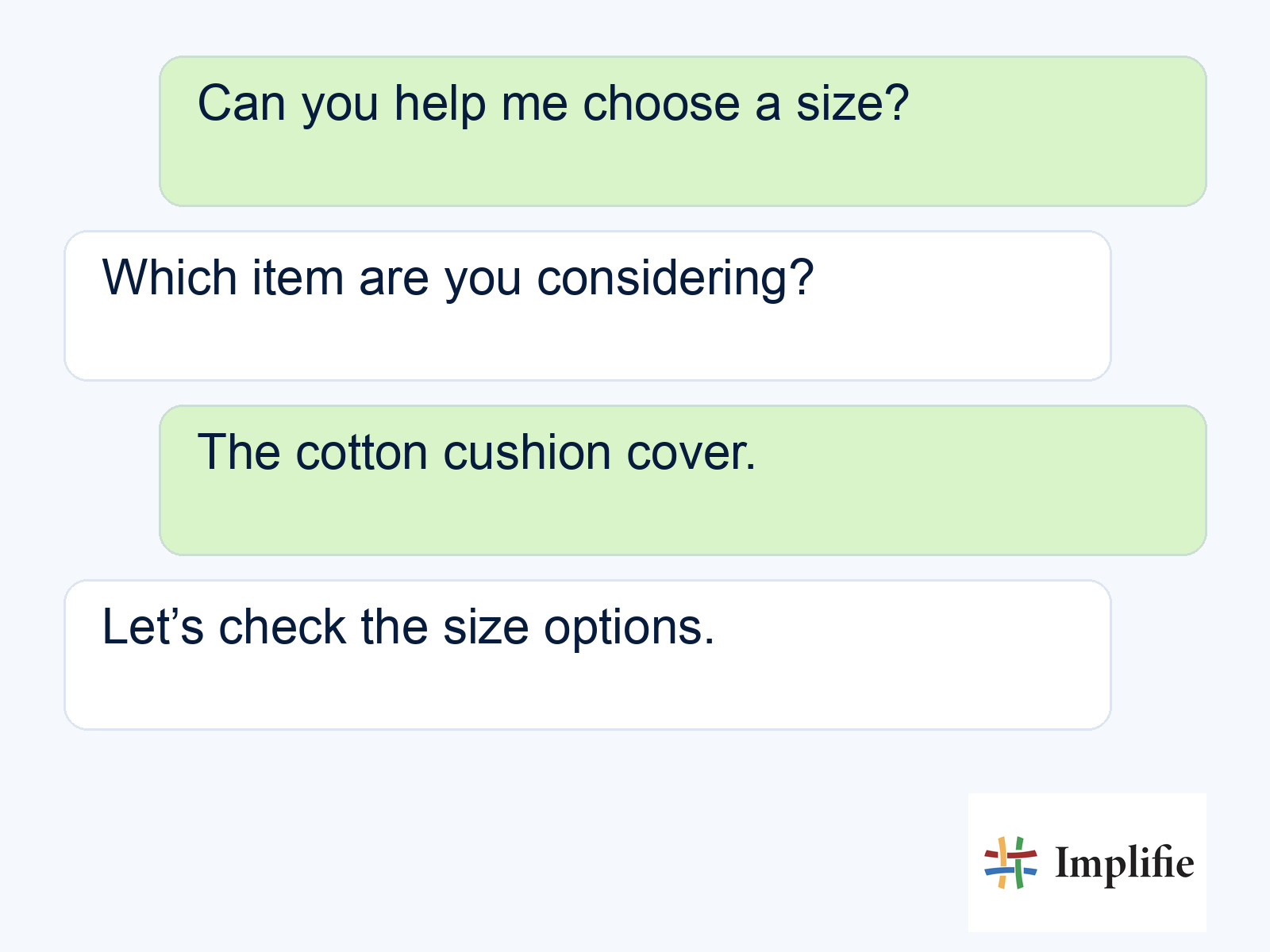
This is where campaign planning meets day-to-day operations. A customer who replies should not have to repeat the question because the marketing and support teams use separate notes. Use a shared inbox and a clear owner to preserve the conversation. If a chatbot workflow collects the initial details, specify where it stops and what context the person receives. Helpful automation makes the handover easier to complete.
Measure your own results before expanding
Define the comparison before sending: audience, offer, campaign period and what counts as a completed purchase or qualified enquiry. Review refunds, discounts, message costs and the time spent handling replies. A result attributed to a campaign is not automatically an additional sale caused by it; some people may have purchased anyway. Where practical, compare a similar eligible group or a reliable baseline, and explain the limits of that comparison when reporting to the team.
Use WhatsApp analytics alongside the store or booking record that confirms the outcome. Change one important variable at a time so a stronger offer does not get mistaken for better message wording. Read complaints and opt-outs as well as revenue. A campaign that creates a short-term spike while exhausting an interested audience may not be a repeatable success. The next investment should follow the evidence from your own customer journey.
Borrow the lesson, validate the implementation
Good WhatsApp marketing success stories help you ask better operational questions: which customer need matters, which information makes the answer trustworthy and who owns the next action? Use the documented examples as starting points, verify the capabilities available to your business and run a focused pilot. Expand when your own completed outcomes and customer feedback support it, rather than turning another brand’s results into a forecast.
Frequently asked questions
Are Tata CLiQ and Magalu Implifie customers?
This article does not make that claim. It discusses examples published by WhatsApp and links to their original case studies.
Can I expect the same conversion results?
No. Market, audience, product, offer and implementation differ. Use the cases to inform a test and evaluate your own verified outcomes.
Should a small business copy an entire enterprise workflow?
Start with one useful customer task and the data and support capacity you already have. Expand only after the smaller journey works reliably.
Does a marketing click count as a purchase?
No. A click is an intermediate action. Confirm a purchase through the authorised store record and use a clear attribution method.
