


A campaign can bring in orders and still lose money. WhatsApp marketing ROI, or return on investment, depends on what those orders contribute after the costs of generating and serving them. A high read rate does not answer that question, and a revenue total can hide heavy discounts or returns. Start by defining the commercial result you want to measure, then connect campaign activity to verified outcomes. No message format or software tool can guarantee a profitable result for every business.
For an ecommerce WhatsApp campaign, that usually means reviewing completed orders alongside contribution margin, message charges and campaign work. Other businesses may need to follow a qualified enquiry through to an actual sale. This guide gives you a practical measurement method and a clearly hypothetical calculation, so you can decide whether to expand, revise or stop a campaign on the basis of your own evidence.
Define WhatsApp marketing ROI before sending
Write down the audience, offer, dates and result that counts. If a campaign aims to recover an abandoned purchase, decide how you will identify the order and how long the attribution window remains open. Exclude cancelled or refunded purchases according to a consistent rule. If another campaign reaches the same customer, record that overlap rather than claiming each channel generated the whole sale. These decisions need to be made before a strong-looking result tempts the team to change the definition.
- Completed outcome: Use a paid order or another confirmed business result, not a click.
- Attribution window: Choose a period appropriate to the buying cycle.
- Contribution: Deduct the variable costs needed to fulfil the sale.
- Campaign investment: Include messaging, relevant platform allocation, creative work and operational costs.
- Comparison: Record the baseline or comparable group used to assess additional outcomes.
Calculate return from contribution, not sales alone
A useful campaign calculation is: return equals additional contribution before campaign costs, minus campaign investment, divided by campaign investment. Multiply by 100 to express it as a percentage. Contribution here means revenue after the variable product, fulfilment, payment and similar costs included in your agreed model. Keep the definition consistent across comparisons. If you only know attributed contribution, label the result as attributed rather than implying that every sale was caused by the campaign.
| Item | Example amount | Meaning |
|---|---|---|
| Additional campaign revenue | ₹20,000 | Assumed additional revenue after the comparison |
| Variable costs and adjustments | ₹12,000 | Product, fulfilment and relevant adjustments |
| Contribution before campaign investment | ₹8,000 | ₹20,000 minus ₹12,000 |
| Campaign investment | ₹5,000 | Agreed messaging, software and execution costs |
| Net campaign contribution | ₹3,000 | ₹8,000 minus ₹5,000 |
| Return on campaign investment | 60% | ₹3,000 divided by ₹5,000, multiplied by 100 |
The calculation changes if the supposed additional sales would have happened anyway. It also changes when returns arrive later or an agent spends substantial time resolving campaign enquiries. Keep those limitations visible in the report. If the comparison is weak, present the result as a provisional estimate and show the assumptions. An honest range is more useful for a spending decision than a precise-looking percentage built on uncertain attribution.
Connect WhatsApp campaign measurement to order records
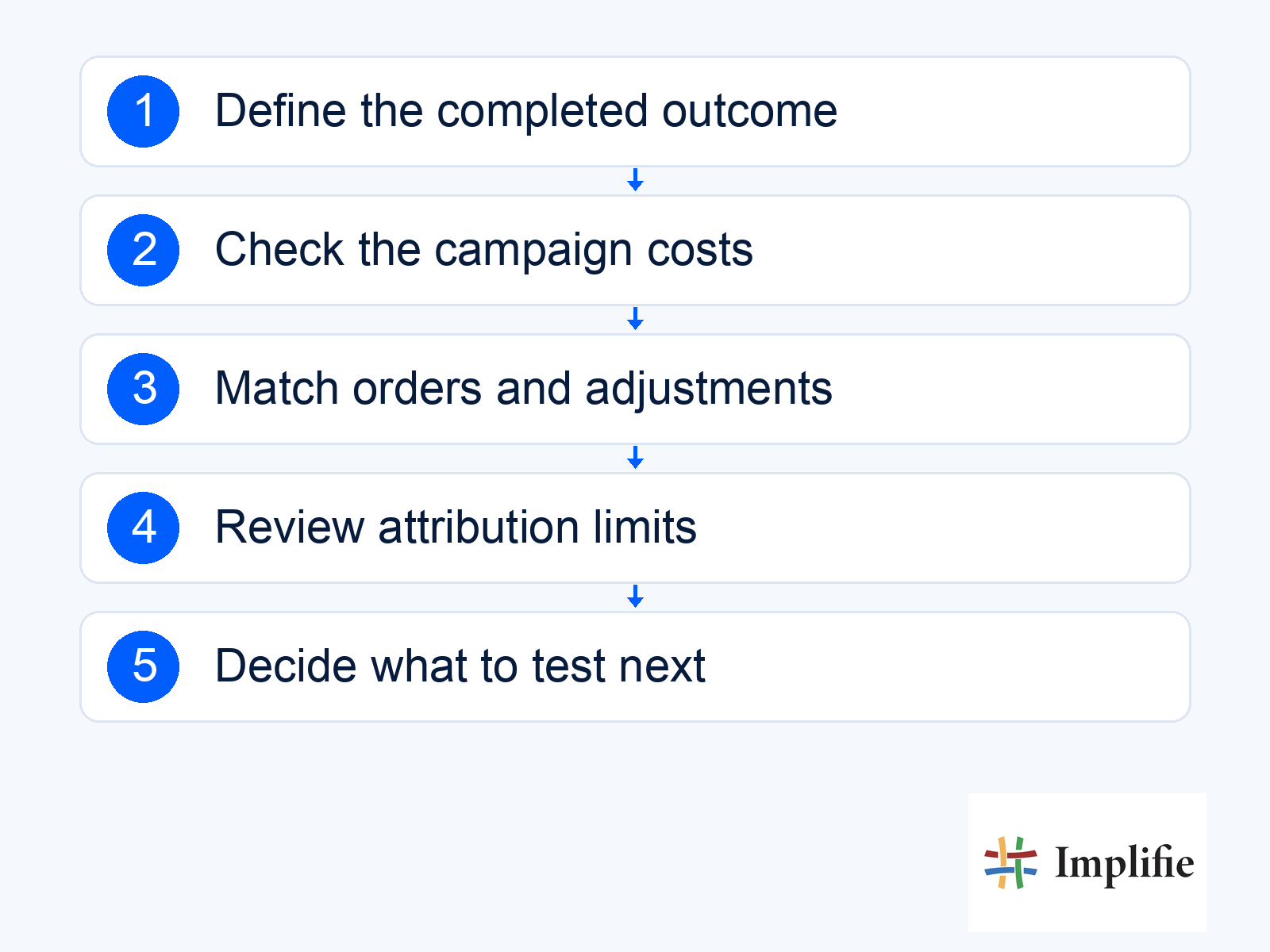
Use campaign identifiers and an agreed purchase record to connect activity with outcomes. WhatsApp analytics can help review message and conversation performance, while the store or customer relationship management system confirms the sale. A CRM record can retain an enquiry and its owner. Verify which identifiers and integrations are available in your setup; do not assume that placing a tracking parameter in a link creates complete attribution automatically.
Keep separate columns for delivered messages, customer replies, clicks where recorded and completed sales. Each answers a different question. Good delivery with few enquiries may suggest the offer is not relevant. Many enquiries with few purchases may expose missing product information or a slow handover. Do not call every reply a qualified lead. Define the qualification criteria and make sure the team records them consistently before comparing campaigns.
Include the cost of handling campaign replies
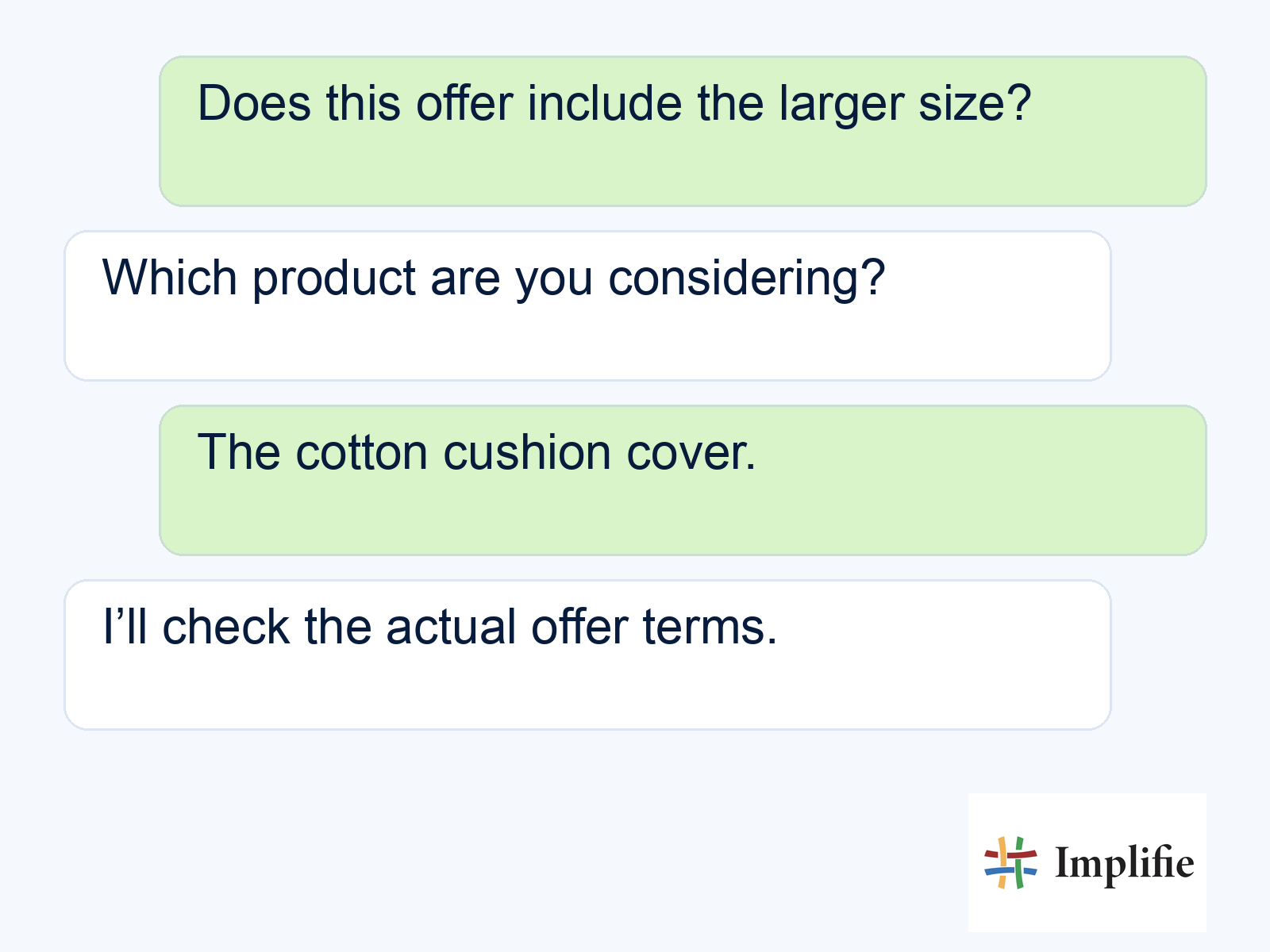
A promotion creates work after the message arrives. Someone may need to check a variant, explain a price or help the buyer complete an order. The illustrative conversation below represents that work; it is not a customer result. Estimate the time required, make current offer information available and assign an owner through the shared inbox. A campaign that overwhelms the team can lose interested buyers even when the message itself performs well.
Check the current Meta message pricing for the recipient market and message category, then add your software and execution costs separately. Avoid using a fixed universal per-message amount or assuming every campaign costs less than another channel. Budget a limited test first. If the team cannot respond within its actual service capacity, reduce the audience or choose a simpler offer instead of paying to create more unanswered conversations.
Improve one decision at a time
Choose the next test from the weakest part of the journey. If interested customers ask the same product question, improve the explanation before changing the send time. If the product is useful but the discount removes the margin, review the commercial offer. Use broadcast planning to keep the audience and message purpose clear, and avoid changing audience, offer and wording at once when you want to understand which change mattered.
Include negative outcomes in the decision: opt-outs, unresolved complaints, cancellations and extra support work. Set a review point and decide what evidence would justify expanding or stopping. A campaign with a small audience may produce a noisy result, so do not treat a handful of purchases as a stable forecast. Repeat an appropriate test or collect more complete data before committing a much larger budget.
Use return as a decision tool
Measure WhatsApp marketing ROI with a clear outcome, a consistent cost model and an honest comparison. Verify completed sales, allow for adjustments and explain attribution limits. Use the result to choose the next practical change rather than to promise a guaranteed return. A repeatable campaign is one whose customer value, operating workload and commercial contribution continue to make sense together.
Frequently asked questions
Is revenue the same as return on investment?
No. Revenue does not deduct product, fulfilment or campaign costs. Define contribution and campaign investment before calculating return.
Does a clicked link prove an additional sale?
No. A click is an intermediate action, and an attributed sale may have happened without the campaign. Explain the comparison used to estimate additional outcomes.
How should later refunds be handled?
Apply a consistent adjustment rule and review the report after a suitable period. Avoid comparing one campaign before returns with another after returns.
Can Implifie guarantee a particular return?
This article makes no such guarantee. Outcomes depend on the audience, offer, implementation, costs and customer response.
